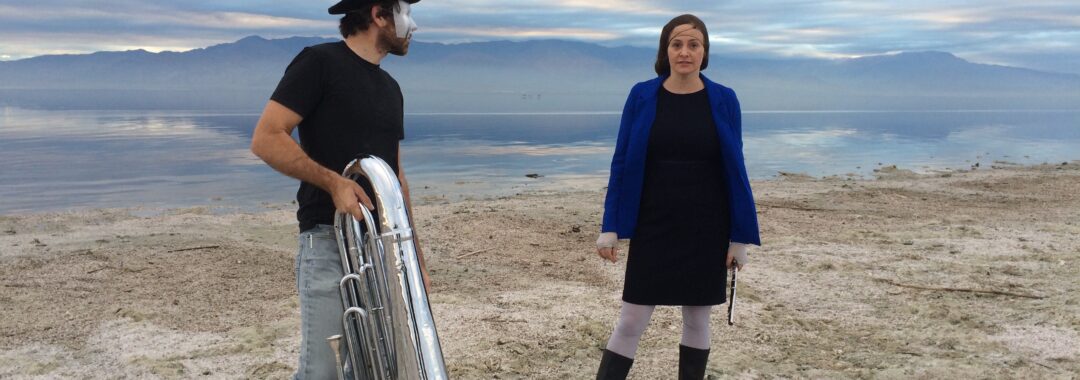

Experimental electronic, noise, ambient, and sound art—all philosophical in some way. Its latest album takes us from birth and its “blooming buzzing confusion,” to our later hyper-individuated lives. Members of the Dept. of Electrophilosophy are philosophers/musicians Marc Bobro, Cedric Bobro, Malcolm Bobro, and the artist Elizabeth Folk.
Elizabeth Folk an interdisciplinary artist and educator working in sculpture, performance, and pedagogy. Folk is most interested in art as a tool for social change and liberation. Her work merges the visual languages of kink, pop-culture, and design to explore and subvert US American myths, narratives, and representations of disabled and femme identities.
Artist Location: Santa Maria, CA
Dept. of Electrophilosophy Social Media:
Elizabeth Folk Social Media:
PARTICIPATION
“To Free the Possible” fully embraces Tin, both sonically and substantially. On a stand in the center of the installation will be a custom made wooden sound box filled with electronic modules, uranium glass, and an internal speaker. Lid halfway open, sounds emanating are driven by radioactive random voltage sources.
One module uses radioactive sources (uraninite aka pitchblende, which often co-occurs with tin), pieces of uranium glass, a Geiger counter, and internal processing to deliver both pure random voltages and random timing/triggers. Each trigger pulse mirrors a beta decay event at the Geiger tube. Analog oscillators, voltage-controlled filters, and amplifiers then use these voltages and triggers to dynamically shape sound, altering waveforms, frequency, and resonance. Randomly generated and modulated, the sounds are never the same.
Nearby, reaching out and into the sound box, will stand a cast metal sculptural companion to the module, by artist Elizabeth Folk.